
Fourth Judicial District Overview
The Fourth Judicial District covers only Hennepin County. The official overview reports 63 judges, 12 referees, and 582 staff working out of five court buildings. The court serves a county of about 1.2 million people in 45 cities. It processes about 40% of all Minnesota case filings, which makes it the largest trial court in the state. One county equals one judicial district here, which is rare in Minnesota; most other judicial districts cover multiple counties.
Hennepin's scale shapes its setup. The court runs separate Criminal, Civil, Family, Juvenile, Probate / Mental Health, Housing, Conciliation, and Treatment Court calendars. It also splits criminal calendars across downtown and two suburban regional centers. The court's case management system feeds MCRO, the statewide public search portal.
Hennepin County District Court Leadership
Court leadership includes Chief Judge Kerry W. Meyer and Assistant Chief Judge Mark J. Kappelhoff. Sara Gonsalves is the Judicial District Administrator. Each major division has a presiding judge.
| Role | Judge or Administrator |
|---|---|
| Chief Judge | Kerry W. Meyer |
| Assistant Chief Judge | Mark J. Kappelhoff |
| Judicial District Administrator | Sara Gonsalves |
| Civil Court presiding judge | Christian M. Sande |
| Criminal Court presiding judge | Hilary L. Caligiuri |
| Family Court presiding judge | Theresa Couri |
| Juvenile Court presiding judge | Todd M. Fellman |
| Probate / Mental Health Court presiding judge | William H. Koch |
| Treatment Courts presiding judge | Amber M. Brennan |
Hennepin County District Court Buildings
Courtrooms and administration sit in five buildings: three downtown Minneapolis buildings and two suburban regional centers. Each building hosts specific divisions. The list below mirrors the official Going to Court page.
| Court / Division | Address | Notes |
|---|---|---|
| Hennepin County District Court (main contact) | 300 South 6th Street, Minneapolis, MN 55487 | Court Contact Center 612-348-6000. |
| Civil Court | Hennepin County Government Center, 300 South 6th Street, Minneapolis | Floors C3-C11 and C13-C19. |
| Conciliation / Small Claims | 300 South 6th Street, 3rd Floor Court Tower | Lower-dollar money disputes. |
| Criminal Court Division 1 | Government Center, 300 South 6th Street, plus Public Safety Facility, 401 4th Avenue South | Floors C3-C11 and C13-C19 at GC; 1st floor at PSF. |
| Criminal Court Division 2 | Brookdale Regional Center, 6125 Shingle Creek Parkway, Brooklyn Center | 1st floor; suburban court information 612-348-2040. |
| Criminal Court Division 3 | Ridgedale Regional Center, 12601 Ridgedale Drive, Minnetonka | 3rd floor; free parking lots. |
| Family Court | Family Justice Center, 110 South 4th Street, Minneapolis | Floors 1, 4, 5, 6. |
| Housing Court | Government Center, 300 South 6th Street, Minneapolis | 3rd floor. |
| Juvenile Court | Juvenile Justice Center, 590 Park Avenue South, Minneapolis | Floors 2 and 3. |
| Probate / Mental Health Court | Government Center, 300 South 6th Street, Minneapolis | Floors C4 and C5. |
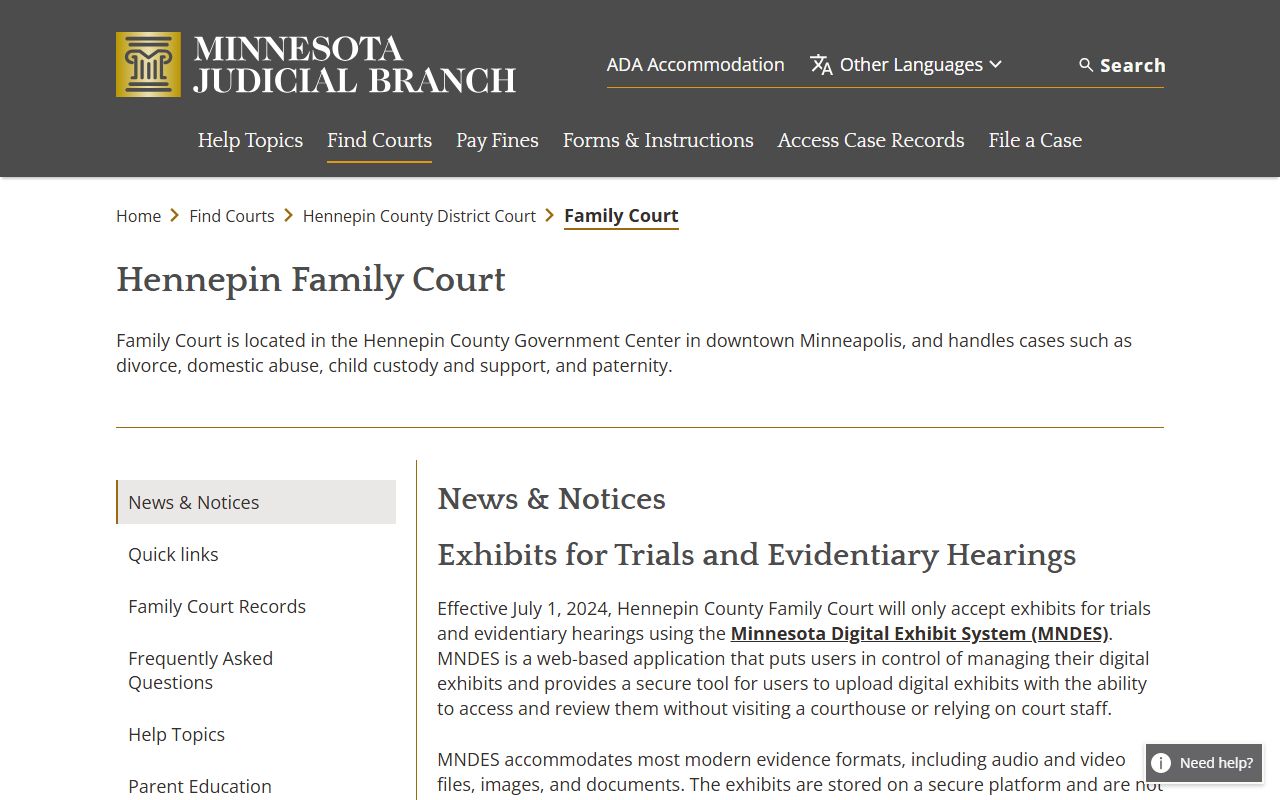
The image above is the Hennepin Family Court page. Family Court is at the Family Justice Center and handles divorce, custody, paternity, child support, and protection orders.
Hennepin County District Court Divisions
Each division handles a defined set of case types. Criminal Court is divided across Government Center, Public Safety Facility, Brookdale, and Ridgedale. Civil Court runs at the Government Center. Family, Juvenile, and Probate / Mental Health each have a dedicated building or wing. Conciliation Court is the small claims division. Housing Court handles eviction and landlord-tenant disputes.
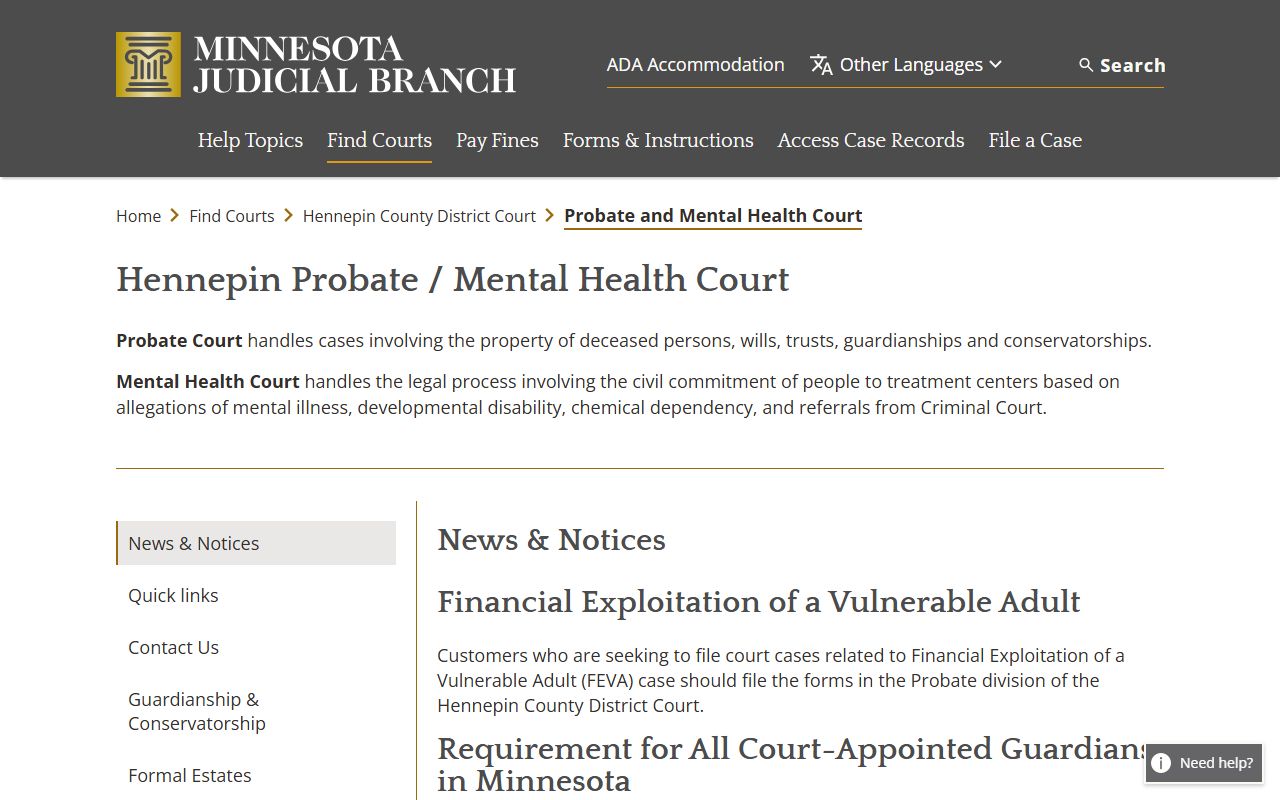
The image above is the Hennepin Probate / Mental Health Court page. Probate / Mental Health Court handles probate, guardianship, conservatorship, trusts, and commitments.
Hennepin Treatment Courts
Treatment courts are specialized calendars inside Criminal Court Division 1. They pull together prosecutors, defense counsel, probation, social workers, and treatment providers around a single calendar. Hennepin runs four named treatment courts.
- DWI Court: voluntary, minimum 18-month post-conviction program for repeat impaired-driving offenders. Began in 2007. Judge Amber Brennan presides Thursdays at 2:00 p.m. and Fridays at 9:00 a.m. in Courtroom C-857.
- Veterans Court: 12-18 month program for veterans charged with criminal offenses who have addiction, serious mental illness, or co-occurring disorders. Began July 2010. Judge Amber Brennan presides Mondays at 9:30 a.m. and 10:15 a.m. in Courtroom C-857. Coordinator Grace Spearman.
- Criminal Mental Health Court: voluntary 12-18 month program for defendants with serious mental illness or co-occurring disorders.
- Model Drug Court: tracks sobriety through treatment, frequent drug tests, court appearances, and sanctions and incentives.
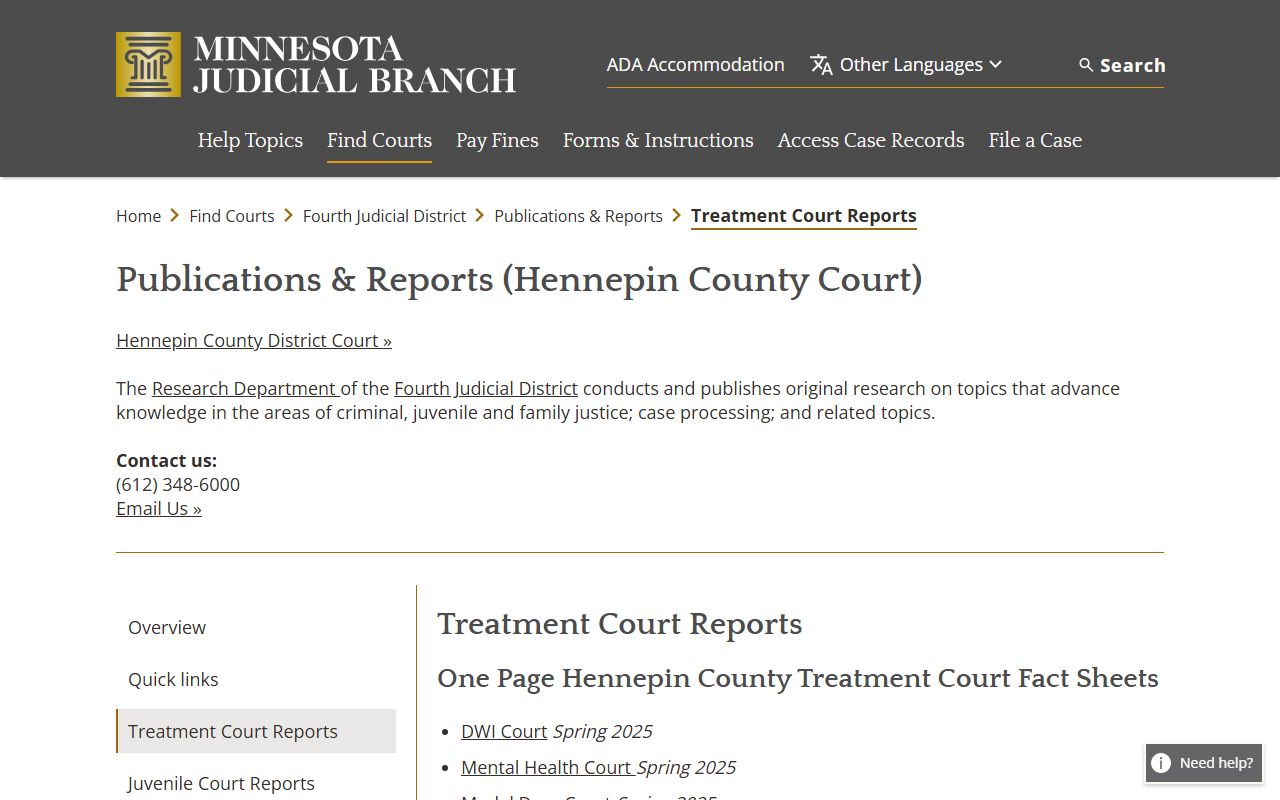
The Fourth District publishes treatment court reports, including Spring 2025 fact sheets and participant surveys. The reports give outcome data for each program.
Minnesota Court Hierarchy and Hennepin County
The Minnesota court hierarchy has three levels above the trial court. Hennepin District Court is the trial court of general jurisdiction. Most appeals go to the Minnesota Court of Appeals. The Minnesota Supreme Court is the court of last resort.
| Hennepin District Court | Minnesota Court of Appeals | Minnesota Supreme Court | |
|---|---|---|---|
| Role | Trial court | Intermediate appellate | Court of last resort |
| Cases | Criminal, civil, family, probate, juvenile, housing, traffic | Most appeals from district courts | Discretionary review, direct review for set matters |
| Location | Five Hennepin court buildings | Minnesota Judicial Center, St. Paul | Minnesota Judicial Center, St. Paul |
| Record source | MCRO | Appellate Case Management System | Appellate Case Management System |
Case flow: Minnesota District Court › Minnesota Court of Appeals › Minnesota Supreme Court
Minnesota does not use county courts at law, justice of the peace courts, or separate municipal courts in the way some other states do. City-issued traffic tickets and ordinance citations route into the District Court Violations / Hearing Office structure. The build of the court here is unified at the state level.
How a Hennepin County Case Moves Through the System
A criminal case typically follows a fixed sequence. The civil case path is different. Both end in either a disposition order at the District Court or a notice of appeal to the Minnesota Court of Appeals.
- Filing: a complaint, petition, or citation is filed with Court Administration. The case is assigned a 27-prefix MNCIS number.
- First appearance or scheduling: criminal cases have a first appearance; civil cases get a scheduling order.
- Pretrial activity: motions, discovery, omnibus and Rasmussen hearings in criminal cases; motion practice and discovery in civil cases.
- Settlement or plea: many cases resolve here through plea, settlement, or dismissal.
- Trial: bench trial or jury trial in unresolved cases.
- Disposition: conviction, acquittal, judgment, decree, dismissal, or other order.
- Post-disposition: sentencing, probation review, satisfaction of judgment, or appeal notice.
- Appeal: notice of appeal to the Minnesota Court of Appeals, with later possible Supreme Court review.
Warrant Helpline at Hennepin District Court
The Hennepin Criminal Court warrant helpline handles inquiries about active warrants. Helpline hours are 8 a.m. to 4:30 p.m., Monday through Friday. Voicemail can be left at any time, and court staff return calls during business hours. Email goes through the Warrant Helpline Contact Form with responses in one to two business days.
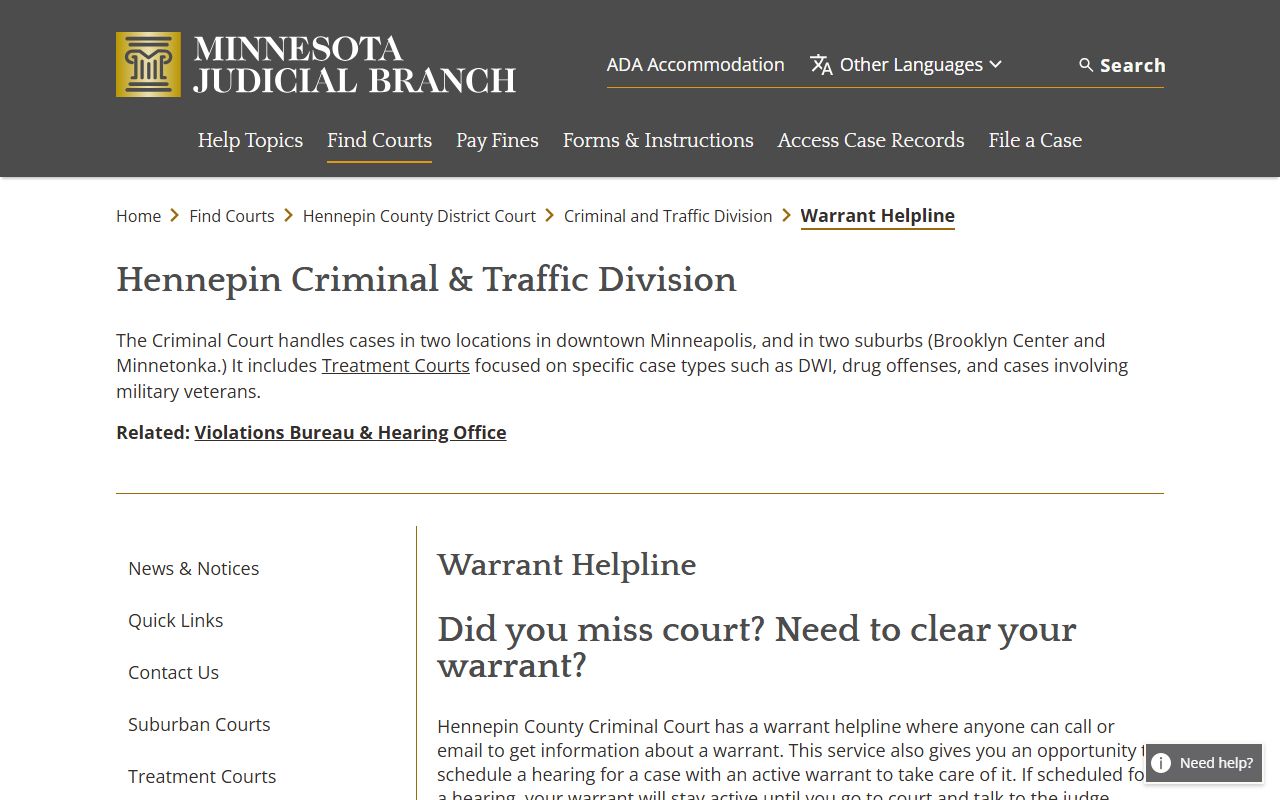
The warrant helpline page lists which warrants can be scheduled for a hearing and which cannot. The warrant records page has the full helpline rules and the resolution paths for ineligible warrants.
Going to Hennepin County District Court
The Going to Court page lists building addresses, courtroom floors, security routing, and visitor tips. The Government Center has an A-Tower and a C-Tower. Courtrooms are mainly in the C-Tower. The Records Center is in A250 on the Skyway Level in the A-Tower. The court suggests using the A-Tower checkpoint and bridge floors when the C-Tower checkpoint is busy.
All Hennepin court locations can be reached by bus or light rail. The Government Center is near Government Plaza light rail station. Suburban courts at Brookdale and Ridgedale have free parking lots. Visitors who need an interpreter or disability accommodation should contact court administration before the hearing.
Note: Rule 4 of the Minnesota Rules of General Practice restricts pictures and voice recordings in courtrooms and courthouse areas with courtrooms, except for the official record or authorized cameras.
Court History Museum
The Fourth District maintains a Court History Museum on the skyway level of the Government Center. The museum has banners and court-related artifacts depicting significant Hennepin County legal events. It is a small but distinctive courthouse feature worth a visit for anyone interested in the local court's history.
Hennepin District Court Research and Publications
The Fourth District has a Research Department that publishes regular reports on treatment court outcomes, court operations, and case flow. Spring 2025 fact sheets and participant surveys cover DWI Court, Mental Health Court, Model Drug Court, and Veterans Court. These reports are useful for media coverage, academic research, and practitioner planning. The publications page also hosts annual statistics and special-topic reports.
For users tracking court reform and policy initiatives, the Hennepin County Attorney's Office posts policy updates and case announcements on its news page. The Hennepin County Sheriff publishes annual reports and a jail data dashboard. The Minnesota Judicial Branch publishes statewide statistics and court rule updates.