
Hennepin County Probate / Mental Health Court
The Hennepin Probate / Mental Health Court is a division of Hennepin County District Court. It sits in the Hennepin County Government Center at 300 South 6th Street, Minneapolis, on floors C4 and C5. Probate Court handles property of deceased persons, wills, trusts, guardianships, and conservatorships. Mental Health Court handles civil commitment proceedings for mental illness, developmental disability, chemical dependency, and criminal-court referrals.
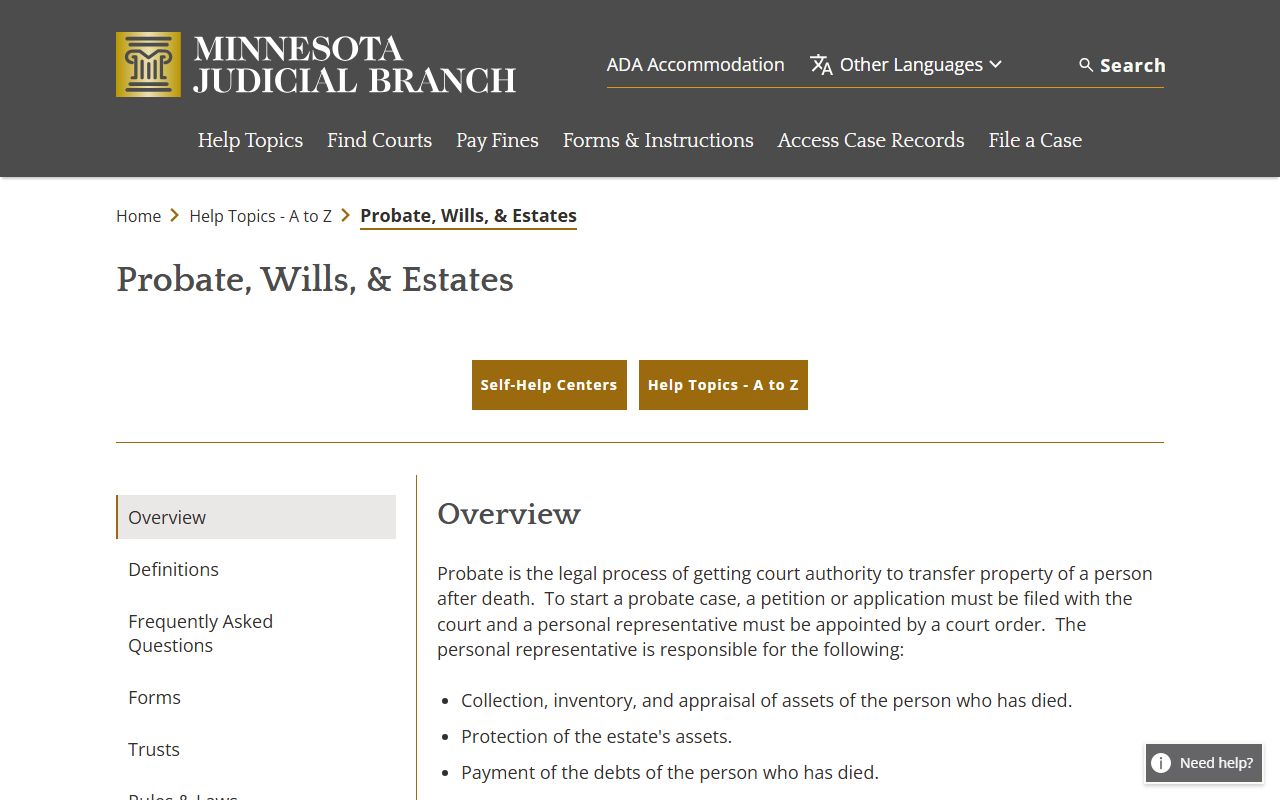
The image above is the Minnesota Probate self-help page. It explains the estate process, will requirements, and the basic decision tree between formal and informal probate. Quick links on the Hennepin Probate page cover Guardianship and Conservatorship, Formal Estates, Informal Estates and Registrars, Wills, Trusts, and Civil Commitments.
What Hennepin County Probate Court Covers
Probate covers more than just wills. Hennepin Probate Court handles cases that involve the transfer of property after death, the management of personal or financial affairs for a person who cannot do so, and the supervision of trusts.
- Estates of deceased persons: formal probate, informal probate, supervised administration, and small-estate alternatives.
- Wills: deposit of wills for safekeeping during life, and admission to probate after death.
- Trusts: court supervision, interpretation, modification, and dispute resolution.
- Guardianships: court appointments to make personal decisions for an incapacitated adult.
- Conservatorships: court appointments to manage finances and property for another person.
- Civil commitments: court-ordered treatment for mental illness, developmental disability, or chemical dependency.
Civil commitment files are public court records but the documents in those cases are not posted on MCRO. They can be reviewed at courthouse public terminals when the law allows, or requested through court administration.
Minnesota Probate Basics
Probate is the legal process of getting court authority to transfer property after death. Minnesota law sets out the basic rules. A will cannot be presented for probate until the decedent has been dead for five days. Formal probate is used when court supervision or judicial decisions are needed, such as disputes, unclear heirs, or complex assets. Informal probate is handled more administratively by a registrar when statutory requirements are met. Small estate collection by affidavit is allowed under Minn. Stat. § 524.3-1201 for qualifying estates.
| Informal Probate | Formal Probate | Small Estate Affidavit | |
|---|---|---|---|
| Court Role | Administrative, by registrar | Judicial, with court orders | No court hearing typically |
| Use Case | Clear will, agreed heirs, no disputes | Disputes, unclear heirs, complex assets | Small estate under statutory limit |
| Time | Faster | Longer | Fastest |
| Five-Day Rule | Yes | Yes | No, but death certificate required |
Hennepin Probate Terms Glossary
Probate uses a specialized vocabulary. The glossary below covers the terms that appear most often on Hennepin probate filings.
- Testator
- The person who made the will.
- Decedent
- The deceased person whose estate is being administered.
- Personal Representative
- The person named in a will or appointed by the court to administer an estate; sometimes called an executor.
- Intestate
- Dying without a valid will; the estate passes under Minnesota intestacy rules.
- Heirs at Law
- People entitled to inherit when there is no will.
- Beneficiary
- A person named in a will or trust to receive property.
- Guardian
- A court-appointed person who makes personal decisions for an incapacitated adult.
- Conservator
- A court-appointed person who manages finances for another person.
- Ward / Protected Person
- The person under a guardianship or conservatorship.
How to Search Hennepin County Probate Records
Hennepin probate records are searched through MCRO Case Search. Probate filings use the 27PR case-type prefix. Public documents in formal probate, other probate, guardianship, conservatorship, and trust case types filed on or after July 1, 2015 may be available remotely. Civil commitment documents are not remote.
| Field | Type | Required | Notes |
|---|---|---|---|
| Name | Text | Optional | Decedent, ward, protected person, petitioner, or party name. |
| Case Number | Text | Optional | Full probate case number when known. |
| Case Category | Checkbox | Recommended | Select Probate or Mental Health. |
| Date Filed | Date / range | Optional | Narrow by filing date. |
| County | Checkbox | Recommended | Select Hennepin. |
| Case Status | Dropdown | Optional | All, Active, Inactive. |
- Open MCRO Case Search and accept the terms.
- Enter the decedent or protected person's name on the Name tab.
- Open Additional Search Options and select Probate or Mental Health as the Case Category.
- Select Hennepin in the county list.
- Click Search and open the case to view the Register of Actions.
- For certified copies of orders or decrees, request through the Records Center.
Hennepin Probate Process Walkthrough
Most Hennepin probate matters follow the same general path. The exact steps depend on whether the case is formal or informal, supervised or unsupervised, and whether disputes arise.
- Decide whether court probate is needed or whether a small-estate affidavit or nonprobate transfer applies.
- Wait at least five days after death before presenting a will for probate.
- Identify venue; usually the county of the decedent's residence, death, or property.
- Choose informal or formal estate process based on assets, disputes, and clarity.
- File the application or petition with the required death certificate, will, and nomination documents.
- Provide required notices to heirs, devisees, creditors, and interested persons.
- The court or registrar appoints a personal representative when appropriate.
- The personal representative collects assets, inventories the estate, pays valid debts and taxes, and distributes property.
- Close the estate by final account, decree, statement, or court order as applicable.
Note: Original wills in Hennepin can be deposited for safekeeping during the testator's life. Contact Probate Court for current procedure.
Guardianships and Conservatorships
Guardianship covers personal decisions for an incapacitated person; conservatorship covers financial decisions. Hennepin Probate Court holds the case file for both. The court appoints the guardian or conservator after a petition, notice, and hearing. Annual reports are filed with the court. The Minnesota Judicial Branch provides forms for guardianship and conservatorship petitions, annual reports, and modifications.
Guardianship and conservatorship documents filed on or after July 1, 2015 may be available remotely in MCRO when public. Some records are restricted by court rule or by judge order to protect the protected person's information. Bank account numbers, medical details, and protected health information are commonly redacted.
Certified Hennepin Probate Copies
Certified copies of probate orders, letters of personal representative, decrees, and other probate documents come from the Hennepin District Court Records Center. The same $14 per certified copy fee that applies to other court documents applies to probate. Bring or send the case number, the document type or title, the date of the order, and the parties involved.
Hennepin Probate / Mental Health Court
Hennepin County Government Center
300 South 6th Street, Floors C4 and C5
Minneapolis, MN 55487
612-348-6000
District Court Records Center
Hennepin County Government Center
300 South 6th Street, Room A250
Minneapolis, MN 55487
612-348-6000
Mon-Fri 8:00 a.m. - 4:30 p.m.
Probate filing fees are set by the Minnesota Judicial Branch and can shift each year. Check the current Court Fees page for the current filing fee, certified copy fee, and any extra service fees.
Hennepin Trust and Conservatorship Matters
Trusts can come before a court for several reasons. A trustee may need court instructions on a beneficiary dispute. A beneficiary may petition for an accounting. A settlor may need a court order to modify or terminate a trust. Hennepin Probate Court handles these trust files alongside its estate work. Trust documents filed on or after July 1, 2015 may be available remotely in MCRO when public, similar to other probate case types.
Conservatorship accounting filings are a major class of Hennepin probate records. Once the court appoints a conservator, the conservator owes the court annual reports and accountings. Failure to file can lead to removal. The Minnesota Judicial Branch provides standard forms for each annual report category.
Probate disputes can move slowly. A contested will, an objection to the appointment of a personal representative, or a claim against an estate often triggers full discovery, mediation, and a contested hearing. Settlement is common. The court keeps an open docket throughout, and the case status can read Active even when the estate has been mostly administered, until a final order closes the file.
Restricted Probate Records in Hennepin County
Some probate records are restricted by court rule or statute. Adoption records are restricted under Minn. Stat. § 259.61 and are not treated like ordinary public civil records. Civil commitment public documents are not available on MCRO. Mental health information in guardianship and conservatorship files can be redacted under Minnesota mental health privacy rules. Sealed probate records require party status, attorney status, or a court order to access.