
How to Look Up Hennepin County Jail Population Data
The Hennepin County Sheriff Jail Data Dashboard is the official live source. The dashboard updates every three hours between 6 a.m. and 9 p.m. daily. It lets users filter by population, demographic data, case type, offense level, and charging agency. The dashboard glossary defines terms such as Annex, Approved capacity, and Operational capacity. Live counts and visualizations are interactive and are best read directly on the dashboard.
Hennepin annual reports and Sheriff news releases also publish summary numbers. Sheriff Dawanna S. Witt launched the public jail data dashboard as part of a transparency commitment inside the Adult Detention Center. The HCSO 2024 Annual Report describes the launch and other Sheriff initiatives. For aggregate data not displayed on the dashboard, the Hennepin Sheriff Data Practice Request Unit processes formal data requests.
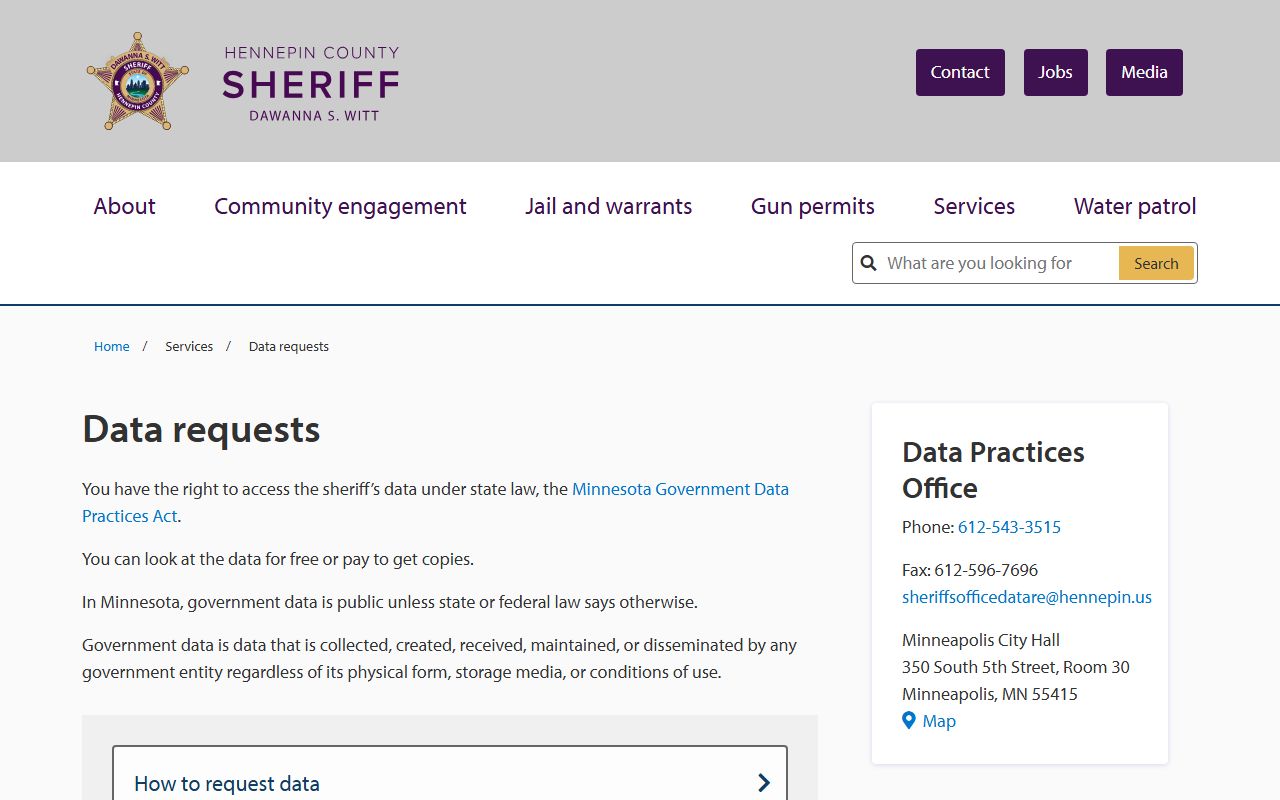
The Sheriff data requests page above is the right route for population data not displayed online. The page covers what to include in a request, response times, and the cost rules under the Minnesota Government Data Practices Act.
Hennepin County Jail Capacity Overview
The Hennepin County Jail, also called the Adult Detention Center, operates from two downtown Minneapolis locations across the street from each other. The Public Safety Facility houses most of the jail population. The City Hall location holds a smaller share. Bed counts use two terms from the dashboard glossary: Approved capacity, the total beds approved for the facility, and Operational capacity, the beds the facility ideally operates at within classification, maintenance, and project needs.
| Facility | Address | Capacity Notes |
|---|---|---|
| Public Safety Facility | 401 South 4th Avenue, Minneapolis, MN 55415 | Main downtown jail; live capacity numbers on the Sheriff data dashboard. |
| City Hall Jail Location | 350 South 5th Street, Minneapolis, MN 55415 | Across the street from PSF; included in total Hennepin jail count. |
The dashboard reports overall jail counts that include both downtown facilities. The Annex category covers people in HCSO custody who have been transferred to another detention or correctional facility. An Annex transfer keeps custody under HCSO even though the person is not physically at the Public Safety Facility or City Hall location.
Note: The current numeric values on the live dashboard change every three hours during operating windows. Always read the dashboard for the current count, not a static citation.
Average Daily Population in the Hennepin Jail
Average daily population is the most-cited jail metric in policy discussions. The Hennepin Sheriff dashboard supports an average-daily-population view that filters by date range, demographic, case type, offense level, and charging agency. National averages from the U.S. Bureau of Justice Statistics put county jails in context. Hennepin should be read against state and national rates because national jail rates have trended down from the early 2010s peak.
Average daily population differs from the snapshot population shown at the top of the dashboard. A snapshot count is the number of people in custody at one moment. Average daily population is the daily mean across a longer period, smoothed against booking and release spikes. Both numbers matter, but they answer different questions.
Demographic Breakdown of the Hennepin Jail Population
The dashboard reports race and gender data that is self-reported during booking. Demographic data are not used as proof of identity. They support transparency and population analysis. The dashboard exposes filters and color-coded charts. Each chart updates when the user changes the date range or another filter.
| Demographic Category | Reported By | Notes |
|---|---|---|
| Race | Self-reported at booking | Categories follow standard government race classifications. |
| Gender | Self-reported at booking | Categories follow standard government gender classifications. |
| Age | Computed from date of birth | Adults only; juveniles are at the Juvenile Justice Center. |
| City of record | Provided at booking | Shown in jail roster detail page for individual records. |
National research from the U.S. Bureau of Justice Statistics and the Vera Institute tracks demographic patterns across U.S. jails. The Hennepin dashboard is the local source; BJS and Vera are useful for context but should not be treated as authoritative Hennepin facility counts.
Pretrial vs Sentenced Population
The Hennepin dashboard tracks pretrial detention separately from sentenced detention. Pretrial detainees are people in custody awaiting trial or another pretrial event. Sentenced detainees have been convicted and are serving a jail term, awaiting transfer to state prison, or serving a probation hold. Pretrial population fluctuates with bail decisions and court calendars. Sentenced population fluctuates with conviction rates, sentence lengths, and transfer schedules.
National jail data from BJS reports that a majority of jail population in the United States is pretrial. Hennepin's pretrial share follows the same broad pattern, though the live percentage on any given day depends on filings, releases, and court actions. The 2024 HCSO Annual Report and Spring 2025 Fourth District treatment court reports add narrative context to the dashboard numbers.
Misdemeanor vs Felony Population
Offense level on the dashboard reflects the primary or most serious charge tied to a booking, not every charge a person faces. Categories run from petty misdemeanor and misdemeanor up to gross misdemeanor and felony. A booking with multiple charges takes the highest severity charge as the primary marker. The dashboard glossary calls this the primary or most serious charge.
Case type categories on the dashboard are internal HCSO categories describing the person's primary or most serious charge. They are not identical to MNCIS case-type letters in the court system. A user comparing dashboard categories to a Hennepin Register of Actions should expect different labels and groupings.
Mental Health and Medical Population
Hennepin handles civil commitment cases in the Probate / Mental Health Court at the Government Center. Criminal Mental Health Court is a separate program in Criminal Court Division 1 for defendants with serious mental illness. The jail itself houses people in custody who may be undergoing mental health screening, medication management, or treatment evaluations. Specific medical and mental health population counts are not always exposed in the public dashboard; the Sheriff Data Practice Request Unit handles formal data requests for those subsets when allowed.
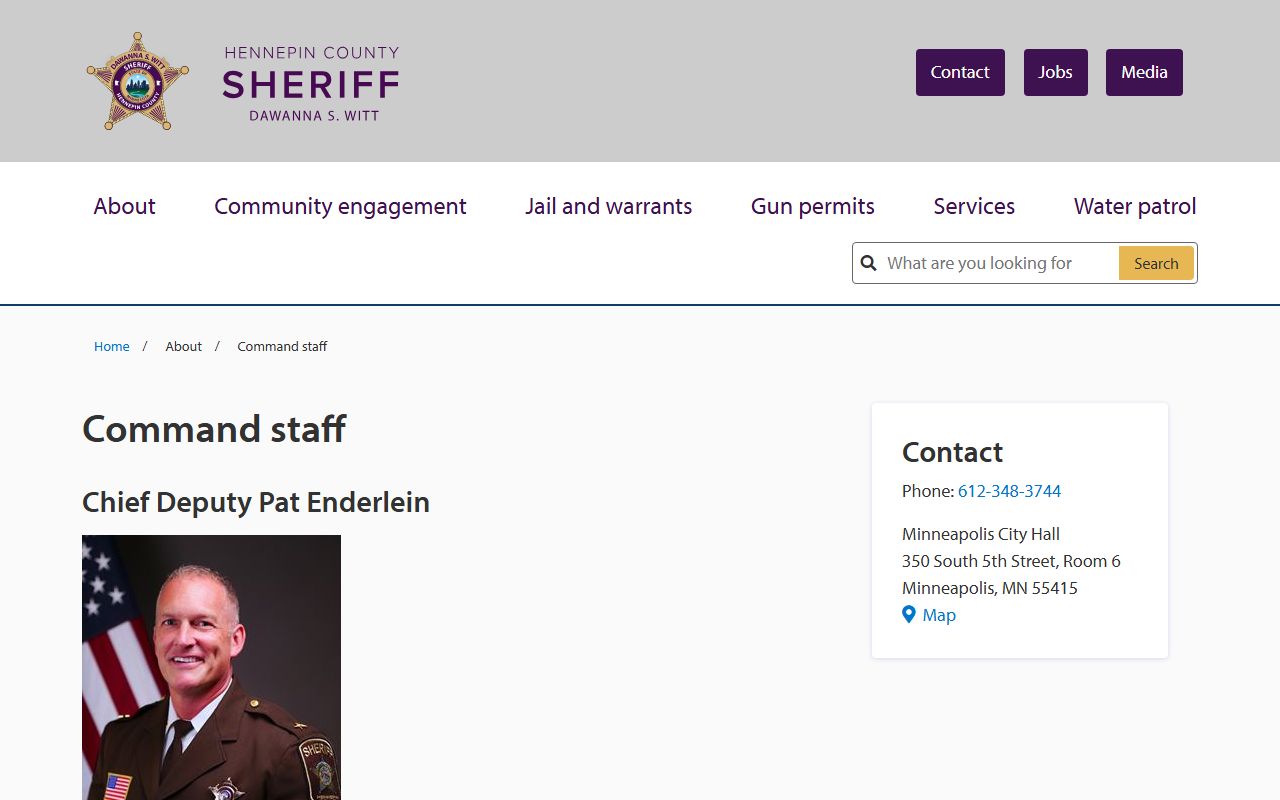
The image above is the Hennepin County Sheriff Command Staff page. The command staff oversees Adult Detention Center operations, including medical and mental health services. The page lists key leadership roles, which is useful for media or research contacts.
National and State Context
The U.S. Bureau of Justice Statistics publishes the Jail Inmates report each year. It tracks rated capacity, average daily population, admissions and releases, and demographic patterns across U.S. county jails. The Vera Institute publishes county-level jail data on its Incarceration Trends platform. Both sources are useful context for Hennepin numbers but should be labeled clearly as national or state context rather than Hennepin facility counts.
| Hennepin County | Minnesota | United States | |
|---|---|---|---|
| Source | HCSO Jail Data Dashboard | Minnesota DOC and MN DPS reports | BJS Jail Inmates and Vera Incarceration Trends |
| Update Frequency | Every three hours during operating window | Annual | Annual |
| Scope | HCSO custody | State prisons plus statewide context | National county jail context |
Population Trends Over Time
HCSO publishes annual reports that summarize jail trends. The 2024 HCSO Annual Report tracks Sheriff Witt's transparency initiatives, including the launch of the public jail data dashboard, the Auto Theft Unit, the reinstated D.A.R.E. program, and Narcan training. The Fourth District publishes treatment court reports that describe how DWI Court, Veterans Court, Criminal Mental Health Court, and Model Drug Court reroute eligible cases from standard jail or prison time.
Hennepin's scale shapes its trends. The county processes about 40% of all Minnesota case filings. A change in Hennepin booking, charging, or bail policy can move the statewide jail population numbers. Compare year-over-year HCSO Annual Reports for the clearest local trend reading. Use BJS and Vera for cross-county comparisons.
Searching for Hennepin County Inmate Records by Name
This page covers population data. Individual name lookups for Hennepin County inmates run through the Hennepin County inmate records page, which uses the Sheriff jail roster. For state DOC and federal BOP searches, see the released inmates page or the linked DOC and BOP locators. The dashboard does not surface a name search; it is built for aggregate counts.
Where the Hennepin Population Data Comes From
Population numbers come from the Sheriff's booking and custody system, the same source that feeds the public jail roster. Race and gender data are self-reported at booking. Case type is the HCSO internal category for the most serious charge. Charging agency identifies the agency that filed the case. Court date data is pulled from the court system through the same data layer used by the public roster API.
The Sheriff publishes the dashboard under its data transparency program. State prison data comes from the Minnesota DOC. Federal data comes from the Bureau of Prisons. National data comes from the U.S. Bureau of Justice Statistics and the Vera Institute. When citing Hennepin jail population numbers, name the source and the capture date because the values change every three hours during the dashboard's operating window.
Hennepin Jail Dashboard Glossary
The Sheriff dashboard uses several terms with specific meanings. Reading the glossary helps interpret the live charts.
- Population
- People currently in Hennepin County jail custody.
- Annex
- A transfer to another detention or correctional facility while custody remains under HCSO.
- Approved capacity
- Total beds approved for the facility.
- Operational capacity
- Beds the facility ideally operates at within classification, maintenance, and project needs.
- Offense level
- The severity of the primary or most serious charge.
- Case type
- HCSO internal category describing the primary or most serious charge.
- Charging agency
- The agency responsible for charging the person in custody.
The dashboard's filters can stack. A user can view, for example, the misdemeanor pretrial population by charging agency for a custom date range. Save the filter URL when sharing a finding with a colleague because the dashboard does not store user sessions.